

The complete guide
What makes a fly swatter last
The problem with plastic swatters
They all fail in the same place. There is a thin moulded neck where the paddle meets the handle, it flexes every time you swing, and after a summer of that it whitens, cracks and snaps.
The paddle usually goes first in a different way: the plastic goes brittle in sunlight, the edge splits, and what is left flaps instead of striking. Either way you buy another one next year.
What is different here
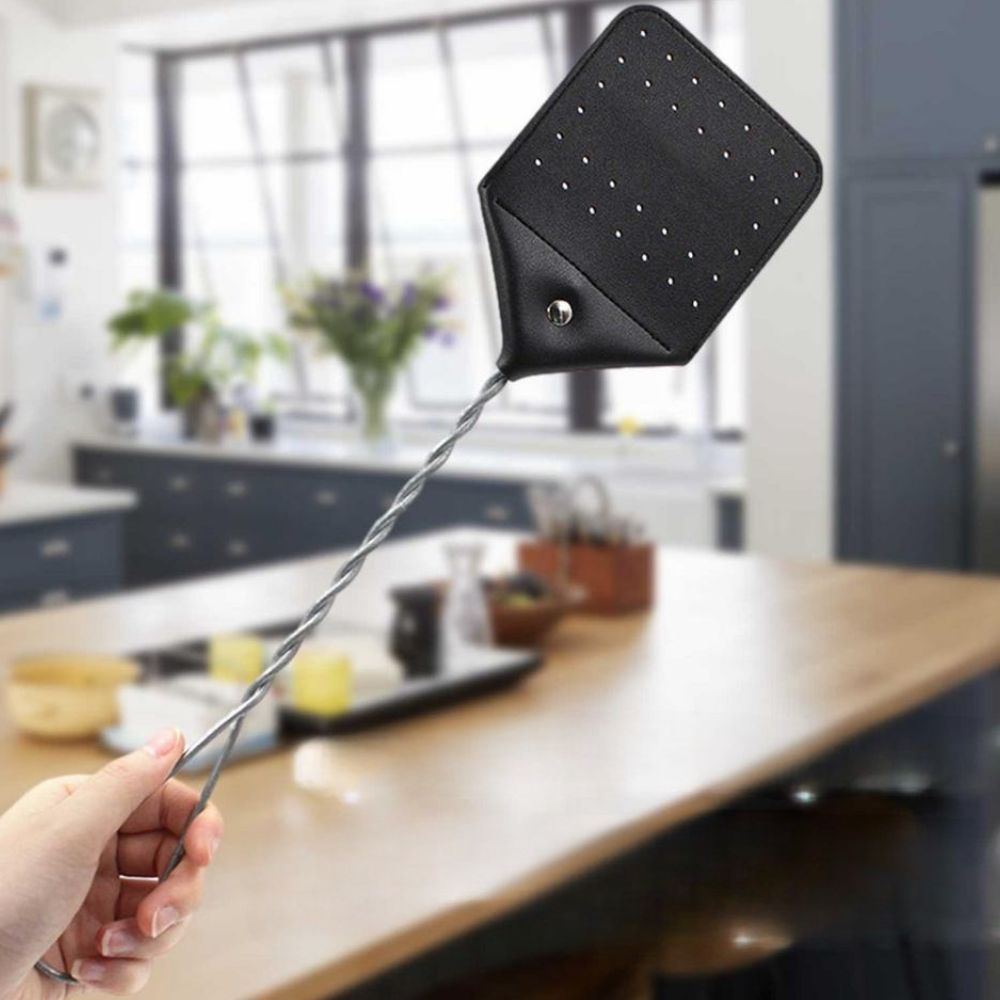
The head is thick PU leather and it is riveted at the junction with the handle. That is a mechanical fixing through the material rather than a moulded joint, so the one point that fails on a cheap swatter is the one point built to take the load here.
The handle is metal, 43 cm of it. Metal does not flex and fatigue the way a plastic stem does, and the length keeps your hand a sensible distance from whatever the fly has landed on.
It is hand made, which is part of why it costs more than a supermarket swatter and part of why it outlives several of them.
Why weight helps
A swatter that weighs almost nothing has to be swung hard, because all the speed has to come from your arm. That is tiring and it is why you miss.
This one has some mass to it, so the swing carries itself. You move it firmly rather than violently and the momentum does the work at the other end. The practical effect is that you connect more often and you can keep going without your arm complaining. The long handle adds tip speed on top of that, because the end of a longer lever moves faster for the same effort.
Keeping it clean
A damp cloth or a paper towel, and it's done. A solid head has nothing to trap anything in, which is the quiet advantage over a mesh paddle: mesh swings faster because air goes through it, but whatever you hit ends up in the holes.
Wipe it rather than soaking it. There's no reason to put a leather head under a running tap.
Where it earns its keep
Kitchens and patios, obviously. Beyond that it is stables, barbecues and caravans, anywhere with a lot of flies and no interest in spraying chemicals around. The reach of the 43 cm handle is what makes it work around animals and food.
For mosquitoes at night, this is the wrong tool. Mosquitoes are easier taken in the air than on a surface, and the electric racket is built for exactly that. The two are not really competitors.